The Oceanography Malta Research Group (Department of Geosciences) offers a M.Sc. in Applied Oceanography, open to both local and foreign students.
Course Co-ordinator: Prof. Alan Deidun
Contact: Mobile: +356 7960 4109; WhatsApp: +356 9974 7657; Landline: +356 2340 3704; Email
[YouTube] OMRG Channel
www ocean.mt
The Course has been offered since 2014 and has opened for the past 5 consecutive years, having trained a total of 63 participants hailing from 13 different countries (representing Europe, North America, Africa and Asia), with all participants being gainfully employed within a marine or maritime related field.
Scholarships are available for the course starting at the end of September 2027.
1 scholarship whereby the awardee will pay EU fees instead of non-EU fees - scholarship equivalent to €11,000.
The total scholarship amount of €11,000 may be shared among more than one non-EU student at the discretion of the Geosciences Department.
Who should apply?
The course is tailor-made for postgraduate students with a first degree in science, geography, earth systems, environmental studies, engineering, architecture or computing as well as to mid-career professionals aiming to supplement their background with a grounding in Oceanography and in marine and maritime studies and willing to augment their academic portfolio with a new suite of capabilities.
The proposed Course is tailor-made for participants aspiring to join several streams of expertise and jobs, amongst others:
- Environmental management of coastal/marine resources
- Policy-making and governance
- Marine Environmental Impact Assessment (EIA) and specialized analysis of environmental scenarios
- Marine-related operational activities such as in surveying, surveillance, search & rescue, marine transportation, etc.
- Environmental monitoring
- Research fields in oceanography
- Numerical modeling of the marine environment
- Data mining, management, quality control and archival
- Marine observations and forecasting.
Course rationale
The course builds on the context and direction provided by the current policy landscape:
which all stress the need for greater capacity-building so as to nurture a new generation of professionals endowed with a novel multi-disciplinary set of skills.
The course is intended to train post-graduate students and professionals on state-of-the-art methodologies and tools to measure, understand and predict the marine environment, and derive sustained benefits from the sea. It is elaborated over a course programme spanning and merging the scientific, technical and applicative aspects of oceanography to offer students a wide-ranging integrated approach, linking science to management, putting technology at the service of users and stakeholders, and providing tools and training for more efficient service-oriented applications.
Targeted areas of such applications include: environmental monitoring and surveillance, assessment and mitigation of risks, marine science-based policy development and strategic planning, climate change, sustainable resource exploitation, ocean governance, marine industries and service provision, and the overall empowerment of human resources to face current and emerging challenges in the marine domain.
Course highlights
- Deployment of oceanographic instruments at sea (first semester). These include:
-
- A Secchi disc
- A Niskin bottle
- A Conductivity, Temperature and Depth probe (CTD)
- Benthic corers
- A week-long bootcamp (second semester) featuring a field (aboard a support vessel) investigation and monitoring of a selected phenomenon (e.g. within Maltese coastal waters involving the use of the following equipment held by the Oceanography Malta Research Group:
-
- Remotely-Operated Vehicle (ROV)
- Benthic grab
- Towed side-scan sonar
- Surface drifters
- Water temperature loggers
- A week-long placement/internship within a local relevant private or public enterprise
- Focus on communication skills through exposure to local media personalities.
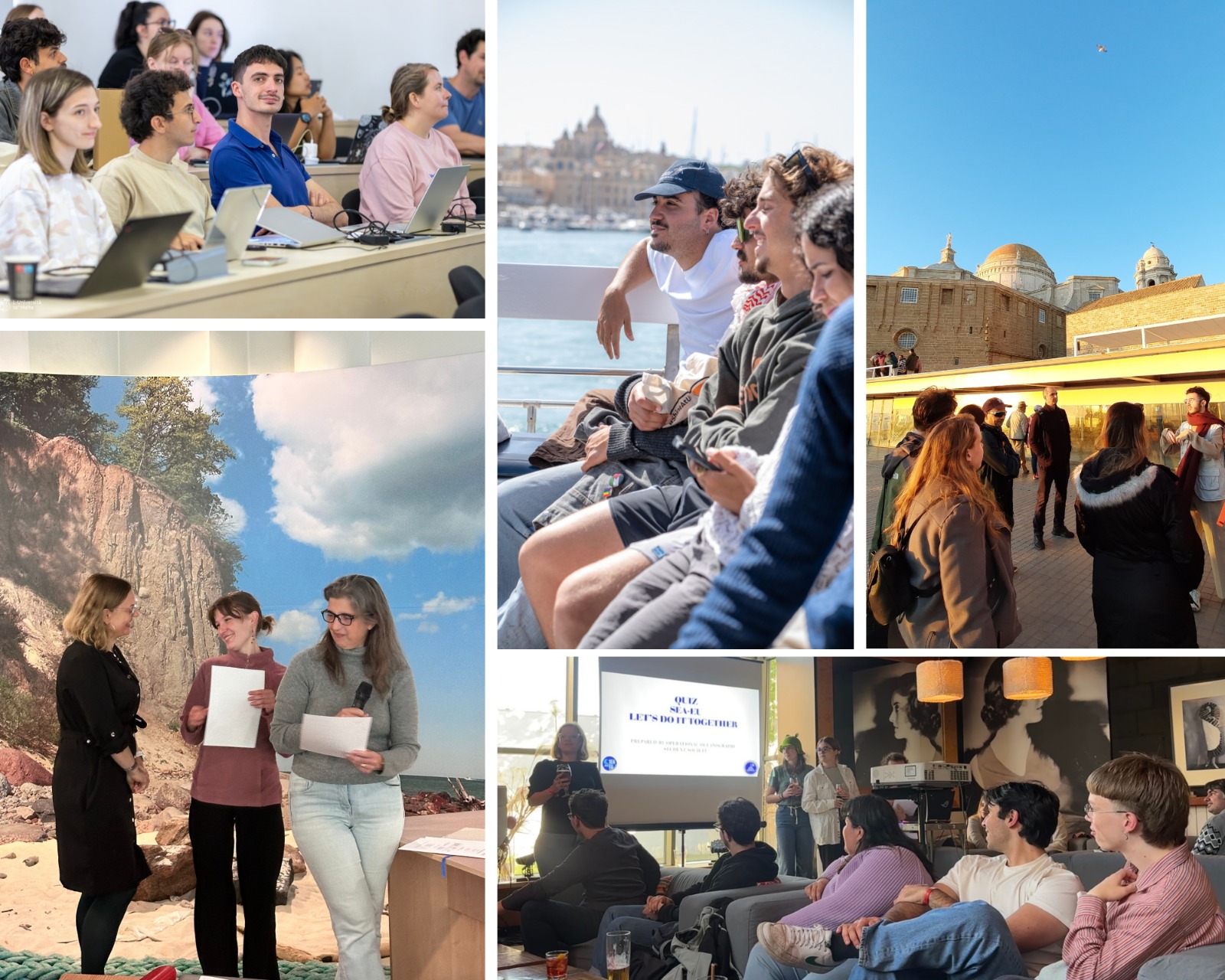
- Participation in the ERASMUS+ Blended Intensive Programme on Marine Data Literacy. Previous editions of the course were hosted by:
-
- University of Cádiz, Spain - 2023
- University of Split, Croatia - 2024
- University of Gdańsk, Poland - 2025
- University of Malta, Malta - 2026
The course is delivered by a diverse, complementary faculty consisting of acclaimed academics from different Faculties at the University of Malta as well as from foreign Universities and research institutes. The Course’s core lecturers are:
Course partners
Local and international partners who are collaborating with the OMRG in hosting MSc in Applied Oceanography students during their placement include a vast selection of public authorities and Ministries, private companies as well as environmental NGOs. These include the following:
What do our students THINK?
There is an interesting article about the course on THINK magazine (Issue 42 pages 42-45) - Deep Dive into a Sea of Wonders.
Read all about BLUE (Buoy for Longterm Underwater Exploration), Malta's first ocean observatory, here.
A sampling of the most recent journal publications emerging from student course dissertations
- Abela, S., Deidun, A., Gauci, A., Gauci, R., 2026. A spatio-temporal study of the presence of vessels within a Natura 2000 Marine Protected Area of the Maltese Islands. Oceans 7(2): 30 https://doi.org/10.3390/oceans7020030
- Mizzi, M.; Deidun, A.; Gauci, A.; Gauci, R. (2024) The Impact of Anchoring on Seafloor Integrity: An Integrated Assessment within a Major Bunkering Area of the Maltese Islands. Geographies 4, 612–629. https://doi.org/10.3390/geographies4040033
- Greiner, B.E., Marrone, A., Mifsud, J., Camilleri, K., Camilleri, L., Gauci, A., Zammit, A., Kossari-Tarnik, E. and Deidun, A., 2024. Exploring the spatial distribution, composition and depth-related patterns of marine litter in Maltese waters: Insights from the MEDITS survey data. In: Philips, N.R., Al-Naeri, S. And Duarte, M. (eds.) Coastlines under Global Changes: Proceedings from the 17th International Coastal Symposium (ICS) 2024 (Doha, Qatar). Journal of Coastal Research, Special Issue No. 113, pp. 396-401. Charlotte (North Carolina) ISSN: 0749-0248. https://www.um.edu.mt/library/oar/handle/123456789/126887
- Grillo, F.; Marrone, A.; Gauci, A.; Deidun, A. Maltese Coastline Never Sleeps: The Effects of Artificial Light at Night (ALAN) on the Local Infralittoral Assemblages—A Case Study. J. Mar. Sci. Eng. 2024, 12, 1602. https://doi.org/10.3390/jmse12091602


